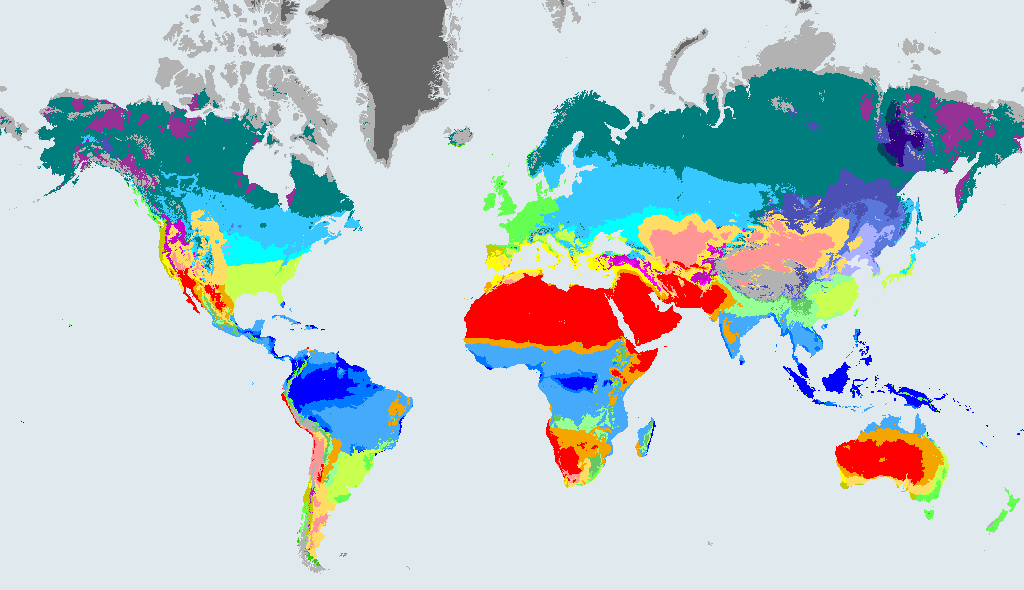
What a Cfc climate is like
Cfc Subpolar oceanic. Mild winters for the latitude but cool summers, with rain through the year. Found on windswept coasts and islands in the far north and south, and at altitude.
The rules behind the code, in plain English:
- Temperate (coldest month between 0 °C and 18 °C).
- No dry season (neither a dry summer nor a dry winter as defined above).
- Cold summer: only one to three months are above 10 °C.
Dataset wording: "Temperate, no dry season, cold summer". In the maps of Beck et al. (2023) the class is written: C: Not B and Thot > 10 and 0 < Tcold < 18; f: Not Cs or Cw; c: Not (a or b) and 1 <= Tmon10 < 4.
Subpolar oceanic climate is cool, damp and breezy, with very short summers and winters that are cold but not extreme, because the sea keeps them in check. Trees struggle in the wind and the cool summer, so the land is often moorland, grass and low shrub. Farming is limited to hardy grass and a few crops, and sheep are common. People wear windproof, waterproof layers in every season.
How much of the world is Cfc?
- less than 0.1%of the world's land outside Antarctica, 1991 to 2020
- 121,998 km²area, 1991 to 2020
- 9cities of 15,000 or more people (GeoNames) have this climate now
In 1901 to 1930 it covered 0.1% of that land, so its area then was 18.09% larger than in 1991 to 2020.
How the Cfc area is projected to change by 2071 to 2099
These figures compare the area of Cfc in each future map with 1991 to 2020. They come from the Beck et al. (2023) model projections under three emissions scenarios. They show what the scenarios imply, not what will happen.
| Map | Share of land | Change in area vs 1991 to 2020 |
|---|---|---|
| 1901 to 1930 (past) | 0.1% | +18.09% |
| 1991 to 2020 (now) | less than 0.1% | - |
| 2071 to 2099, SSP1-2.6 (low emissions) | 0.1% | +16.67% |
| 2071 to 2099, SSP2-4.5 (middle of the road) | less than 0.1% | +4.22% |
| 2071 to 2099, SSP5-8.5 (high emissions) | less than 0.1% | -15.06% |
Shares are of land outside Antarctica. A negative change means the zone shrinks.
What happens to today's Cfc land
Of the land that is Cfc in 1991 to 2020, this is how much stays Cfc and where the rest ends up in 2071 to 2099, by scenario:
| Scenario (2071 to 2099) | Stays Cfc | Where the rest goes (biggest first) |
|---|---|---|
| SSP1-2.6, low emissions | 56% | Cfb (42%), BSk (1%), Csc (0.8%) |
| SSP2-4.5, middle of the road | 21% | Cfb (75%), BSk (3.2%), Csb (0.8%) |
| SSP5-8.5, high emissions | 0.2% | Cfb (91%), BSk (7.6%), Csb (1.6%) |
Looking back, 73% of today's Cfc land was also Cfc in 1901 to 1930. The rest was ET (12%), Dfc (11%), Csc (1.9%), Cfb (1.5%).
Where Cfc is found
The countries with the most Cfc land in 1991 to 2020:
| Country | Area | Share of all Cfc | Share of the country |
|---|---|---|---|
| Chile | 49,799 km² | 41% | 6.9% |
| Argentina | 12,290 km² | 10% | 0.4% |
| New Zealand | 11,015 km² | 9% | 4.2% |
| Falkland Islands | 7,832 km² | 6.4% | 73% |
| Iceland | 7,434 km² | 6.1% | 7.4% |
| United Kingdom | 7,433 km² | 6.1% | 3.1% |
| United States | 6,570 km² | 5.4% | less than 0.1% |
| Australia | 3,849 km² | 3.2% | less than 0.1% |
Places with a Cfc climate today
The biggest cities in the 1991 to 2020 map that sit in Cfc (at most two per country):
- Reykjavík, Iceland
- Punta Arenas, Chile
- Río Grande, Argentina
- Kópavogur, Iceland
- Puerto Natales, Chile
- Tórshavn, Faroe Islands
Other temperate climates (group C)
Frequently asked questions
What does Cfc mean in the Köppen climate classification?
Temperate (coldest month between 0 °C and 18 °C). No dry season (neither a dry summer nor a dry winter as defined above). Cold summer: only one to three months are above 10 °C. The code is a short way of writing that: the first letter is the major group (C, temperate) and the letters after it say more about rain and temperature.
What is a subpolar oceanic climate like?
Cool, damp and breezy, with very short summers. Mild winters for the latitude but cool summers, with rain through the year. Found on windswept coasts and islands in the far north and south, and at altitude.
How much of the world has a Cfc climate?
less than 0.1% of the world's land outside Antarctica was Cfc in 1991 to 2020, about 121,998 km² (Beck et al. 2023, 1 km maps).
Will the Cfc climate zone grow or shrink?
Under the middle-of-the-road scenario (SSP2-4.5), the area of Cfc in 2071 to 2099 is 4.22% larger than in 1991 to 2020. This is a model projection, not a forecast, and it differs under other scenarios (see the table on this page).
Data: Beck et al. (2023), CC BY 4.0. See data sources and licences. Köppen-Geiger classes describe long-term averages, not weather.