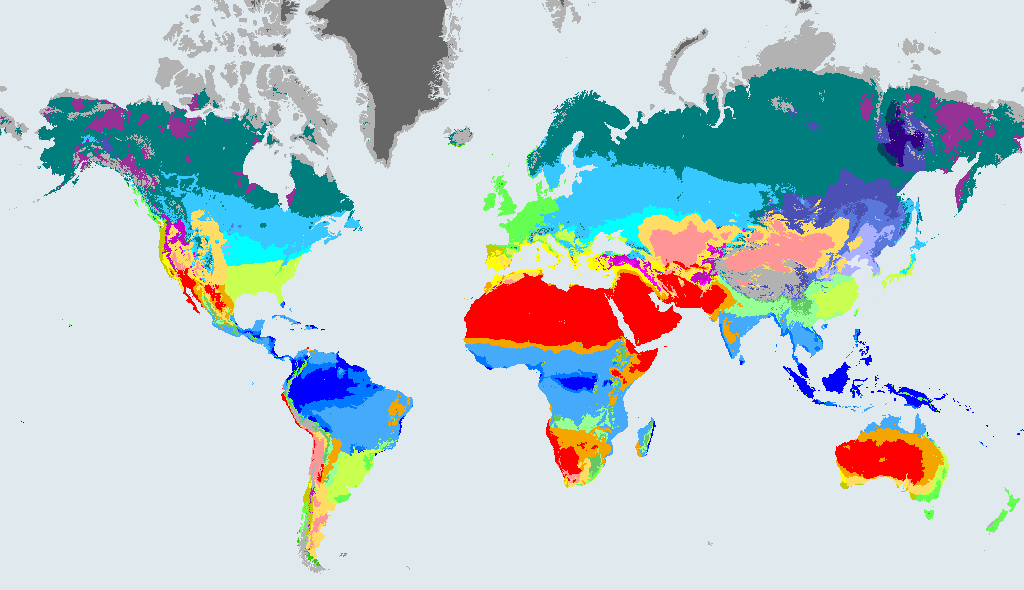
What a BWk climate is like
BWk Cold desert. A desert because of dryness, but cooler on average than a hot desert, often with cold winters. Typical of high plateaus and continental interiors.
The rules behind the code, in plain English:
- Arid, and dry enough to be a desert: yearly rainfall is below five times the threshold.
- Cold: mean annual temperature below 18 °C.
Dataset wording: "Arid, desert, cold". In the maps of Beck et al. (2023) the class is written: B: MAP < 10 x Pthreshold; W: MAP < 5 x Pthreshold; k: MAT < 18.
Cold desert climate is very dry, with cool or cold conditions through the year rather than the heat of a hot desert. Winters can be bitter, summers warm to hot by day, and the air is dry enough that nights are cold. Sparse shrubs and grass cover the ground, and farming depends on irrigation or on herding. Warm layers matter as much as sun protection here.
How much of the world is BWk?
- 3.9%of the world's land outside Antarctica, 1991 to 2020
- 5,215,603 km²area, 1991 to 2020
- 300cities of 15,000 or more people (GeoNames) have this climate now
In 1901 to 1930 it covered 4.3% of that land, so its area then was 11.43% larger than in 1991 to 2020.
How the BWk area is projected to change by 2071 to 2099
These figures compare the area of BWk in each future map with 1991 to 2020. They come from the Beck et al. (2023) model projections under three emissions scenarios. They show what the scenarios imply, not what will happen.
| Map | Share of land | Change in area vs 1991 to 2020 |
|---|---|---|
| 1901 to 1930 (past) | 4.3% | +11.43% |
| 1991 to 2020 (now) | 3.9% | - |
| 2071 to 2099, SSP1-2.6 (low emissions) | 3.3% | -15.15% |
| 2071 to 2099, SSP2-4.5 (middle of the road) | 3.2% | -16.15% |
| 2071 to 2099, SSP5-8.5 (high emissions) | 3.2% | -17.4% |
Shares are of land outside Antarctica. A negative change means the zone shrinks.
What happens to today's BWk land
Of the land that is BWk in 1991 to 2020, this is how much stays BWk and where the rest ends up in 2071 to 2099, by scenario:
| Scenario (2071 to 2099) | Stays BWk | Where the rest goes (biggest first) |
|---|---|---|
| SSP1-2.6, low emissions | 81% | BWh (9.5%), BSk (8.5%) |
| SSP2-4.5, middle of the road | 78% | BWh (15%), BSk (6.6%) |
| SSP5-8.5, high emissions | 70% | BWh (25%), BSk (4.2%), BSh (1%) |
Looking back, 92% of today's BWk land was also BWk in 1901 to 1930. The rest was BSk (8.1%).
Where BWk is found
The countries with the most BWk land in 1991 to 2020:
| Country | Area | Share of all BWk | Share of the country |
|---|---|---|---|
| China | 1,737,509 km² | 33% | 19% |
| Mongolia | 646,249 km² | 12% | 41% |
| Kazakhstan | 604,412 km² | 12% | 22% |
| Argentina | 384,001 km² | 7.4% | 14% |
| Uzbekistan | 315,846 km² | 6.1% | 71% |
| Turkmenistan | 303,339 km² | 5.8% | 64% |
| Chile | 228,290 km² | 4.4% | 32% |
| United States | 193,413 km² | 3.7% | 2.1% |
Places with a BWk climate today
The biggest cities in the 1991 to 2020 map that sit in BWk (at most two per country):
Other arid climates (group B)
Frequently asked questions
What does BWk mean in the Köppen climate classification?
Arid, and dry enough to be a desert: yearly rainfall is below five times the threshold. Cold: mean annual temperature below 18 °C. The code is a short way of writing that: the first letter is the major group (B, arid) and the letters after it say more about rain and temperature.
What is a cold desert climate like?
Very dry, with cool or cold conditions through the year. A desert because of dryness, but cooler on average than a hot desert, often with cold winters. Typical of high plateaus and continental interiors.
How much of the world has a BWk climate?
3.9% of the world's land outside Antarctica was BWk in 1991 to 2020, about 5,215,603 km² (Beck et al. 2023, 1 km maps).
Will the BWk climate zone grow or shrink?
Under the middle-of-the-road scenario (SSP2-4.5), the area of BWk in 2071 to 2099 is 16.15% smaller than in 1991 to 2020. This is a model projection, not a forecast, and it differs under other scenarios (see the table on this page).
Data: Beck et al. (2023), CC BY 4.0. See data sources and licences. Köppen-Geiger classes describe long-term averages, not weather.